Unexpected Signal Facts & Trivia
Do you think "Green means Go"?
Driving rules in Japan can be very different from your home country.
We explain the "True Rules" to help you avoid failing the exam or causing accidents.
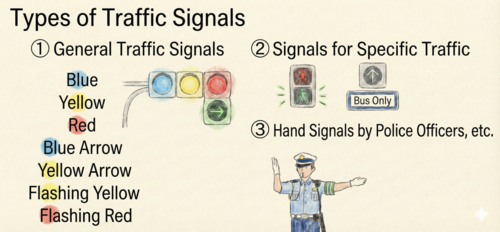 ▲ There are 3 types: Traffic Lights, Special Signals, and Hand Signals
In Japan, besides standard traffic lights, there are specific signals for buses/pedestrians, and "Hand Signals" by police officers during disasters.
"Green" is NOT "Go"!
Many think "Green = Go (Order)", but correctly it means "You MAY proceed".
Why do Japanese say "Blue" (Ao)?
In Japan, the green traffic light is called "Ao" (Blue).
If your instructor says "Look at the Ao signal," they mean the Green light!
What does that mean?
If the intersection ahead is congested, you must NOT proceed even if the light is green. Entering would cause gridlock.
The correct meaning is "You may go only if it is safe."
"Yellow" means "STOP"!
Yellow does not mean "Speed up."
The basic rule is "STOP (Do not proceed beyond the stop line)".
"It's yellow! I need to speed up to make it!"
→ In Japan, this causes accidents.
"Yellow! Prepare to brake."
(Proceed ONLY if sudden braking would be dangerous.)
No "Left Turn on Red"
Crucial Difference!
In many countries (like the US or Philippines), you can turn right on red if it's safe.
In Japan (driving on the left), the equivalent is a left turn.
However, turning left on red is strictly PROHIBITED in Japan.
You can turn only if a "Green Arrow" is lit. If there is no arrow, you must wait for the green light.
Flashing Signals
Meaning differs greatly by color.
| Type | Meaning |
|---|---|
| 🟡 Flashing Yellow |
Proceed with caution. You don't have to stop, but slow down and check for pedestrians. |
| 🔴 Flashing Red |
You MUST Stop Temporarily. Same as a "Stop" (Tomare) sign. Stop wheels completely and check safety. |
Police Hand Signals
Used during power outages or disasters.
[Image of Police hand signals]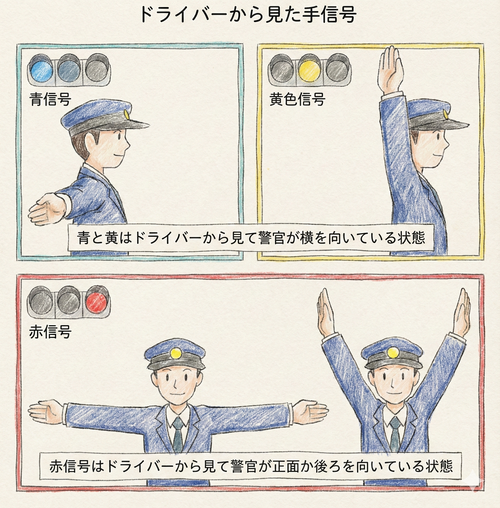 ▲ Meaning depends on the officer's orientation relative to you
The key is which way the officer is facing you.
| Officer's Direction | Meaning |
|---|---|
|
Facing Front (or Back) (You see their chest or back) |
ALWAYS ● Red Signal (Stop) |
|
Facing Sideways (You see their profile) |
Arms Spread: ● Green Signal Arms Raised: ● Yellow Signal |
At night, they use a "Red Lighted Baton".
Priority Order
If signals contradict, follow this priority:
-
1
Police Officer
Highest priority. If an officer says "Go" on a red light, you go. -
2
Traffic Light
If no police officer, follow the light. -
3
Security Guard
No legal authority. Even if they say "Go", if the light is red, you MUST stop.
Drive safely and Good luck with your exam!
Test your knowledge!